What an OnlyFans Management Agency Actually Does — And How to Pick One That Won't Burn You
An unvarnished look at what OnlyFans management agencies really do, what they charge, which services matter most, and the red flags to watch for before signing any contract.
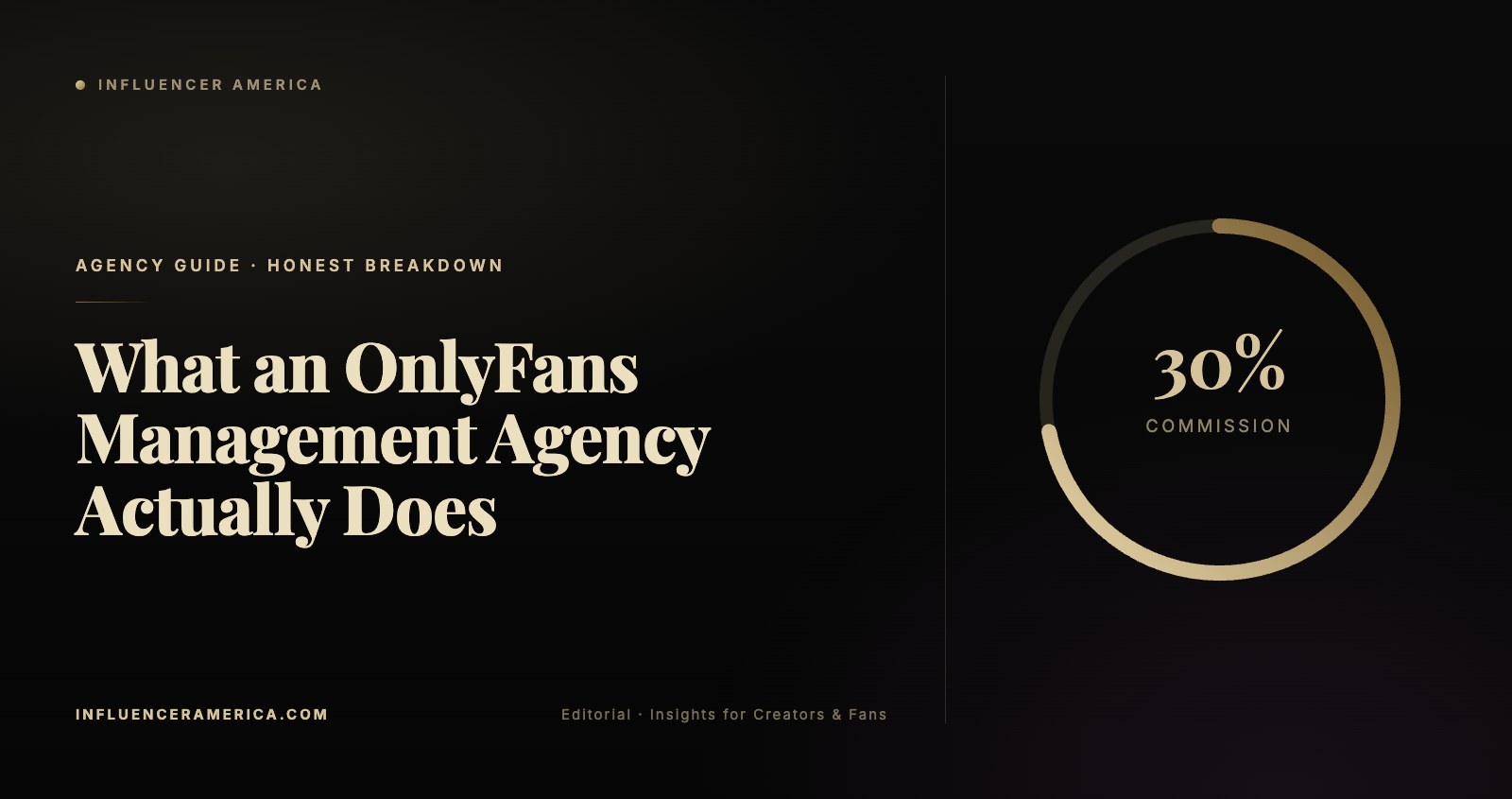
An OnlyFans management agency is, at its best, a professional services firm that runs the business of a creator's career so the creator can focus on actually being a creator. At its worst, it's a rent extractor that locks you into bad terms and takes credit for your own work. The gap between those two versions is enormous — and the creators who survive and thrive in this industry are almost always the ones who learned to tell them apart before signing anything.
This guide is an unvarnished look at what a real, reputable agency actually does, what it costs, what it's worth, and what red flags should send you running the other way. If you've been considering working with an OnlyFans management agency and want an honest inside view, start here. For context on the broader subscription creator economy, our guide to what a premium content creator is covers the fundamentals; if you're still figuring out the economics, see our breakdown of how much OnlyFans creators actually make.
What a full-service agency actually does
The phrase "OnlyFans management" gets thrown around loosely. A useful way to think about it is in terms of the actual work a reputable full-service agency takes off your plate:
Content strategy and scheduling. Which days you post, how much, what types of content, what the month's PPV theme is, how new content gets cross-promoted. A good agency runs this as a deliberate calendar, not an ad-hoc feed.
Chat management, 24/7. This is the single highest-leverage service an agency provides. A human team, trained on your personality and boundaries, responds to fan messages around the clock. Fans spend dramatically more when they get fast, warm, on-brand replies. This is the work that most solo creators burn out doing.
Pay-per-view (PPV) campaign design and execution. Pricing content, segmenting the subscriber list, writing the messages, and running promotions. PPV is often the largest revenue driver on the platform — and it is a learned skill.
Paid promotion and cross-platform marketing. Running ads on Twitter/X, Reddit, and other channels; coordinating shoutouts and collaborations; funneling organic followers into the subscription account.
Platform and banking relationships. Verification paperwork, payout account hygiene, banking/processor issues, dealing with OnlyFans support when something breaks. Creators who've ever had their account flagged know how valuable this is.
Contract and vendor management. Dealing with collab partners, videographers, editors, photographers — and making sure money and rights flow the right way.
Account security. Secure credential storage, 2FA, access control, incident response if something gets phished or compromised. Most creators do not take this seriously until they've lost access to their account. By then it's expensive.
Creative direction and trend work. A good agency sees patterns across its roster and can advise on what's working: which formats, which price points, which collaboration styles, which platforms are rising.
What an agency does not do
Equally important is what a reputable agency should never do on your behalf:
- Pretend to be you, dishonestly. Chat teams work in your voice, with your approval — but reputable agencies are not in the business of running "catfish" operations or fabricating personas. Healthy fan relationships can't be built on lies.
- Produce or distribute content you didn't consent to. Ever.
- Control your personal accounts outside the scope of the contract. Your personal social media, your banking, your IDs — those stay yours.
- Lock you in with contracts that have no exit. More on this below.
- Make promises about "guaranteed earnings." No one can guarantee a revenue number. A good agency will forecast, project, and commit to process — not to a dollar amount.
The commission structures that actually exist
The range of commission structures in this industry is wider than most creators realize. Here's a straightforward breakdown.
Consulting only (5–15%) — You still do everything. The agency gives you playbooks, templates, and periodic strategic advice. Good for creators who want a fractional brain-trust but want to retain full operational control.
Chat management only (15–25%) — The agency runs your DMs, runs PPV campaigns through the DM inbox, and manages fan relationships. You still do content and marketing. This is a popular middle-ground for creators who have their content flow locked in but are getting killed by chat volume. (For a deeper look at what a professional chat operation actually does — and why DMs drive 40–70% of most creators' revenue — see our chat management strategy guide.)
Full-service management (30–40%) — The agency runs the business: chat, content scheduling, promotion, platform ops, and increasingly creative direction. You focus on producing content and being the face of the brand. This is the tier most professional creators over $10k/month end up at.
Custom arrangements — Some agencies use blended models (e.g., 25% base + a 10% bonus on PPV revenue), tiered splits that decrease as revenue grows, or revenue-minimum guarantees. These can be reasonable, but complexity is also a place where bad deals hide. Read carefully.
The gross vs net question. Always clarify whether the percentage is calculated on gross revenue (what the fan pays) or on net of platform fee (what you receive after OnlyFans' 20% cut). A 30% fee on gross works out to 37.5% of what you actually receive — a meaningful difference over a year.
How to evaluate an agency before you sign
Most creators sign their first agency contract without doing the due diligence they'd do on a car lease. Don't. Here's the minimum:
Ask to speak to current creators on the roster. A reputable agency will connect you (with the creator's consent) to one or two existing clients. Ask them: What has the agency actually done for you? Has revenue grown? How fast do they respond when something breaks? Would you sign again?
Read the contract like it's a mortgage. Pay attention to: commission percentage, whether it's calculated on gross or net, contract length, exit clauses, non-compete language, credential-handling policies, and what happens to your account if you leave.
Verify the track record. How long has the agency been operating? How many creators are on the roster? What's the average tenure of a creator on the roster? (High churn is a red flag.)
Understand the team. Who's actually doing the work? How many chatters? How are they trained? Are they employees or contractors? What's the management ratio (how many creators per account manager)?
Clarify escalation and communication. Who do you call when something goes wrong at 2 AM? How quickly do you get a response? What does the weekly reporting look like?
Start with a trial period if possible. 30–60 days lets you see the team in action before you're locked into a long-term contract.
Red flags that should end the conversation
Some things should be immediate deal-breakers. If you see any of these, walk:
- Commission above 45%. There are narrow edge cases (aggressive upfront marketing investment into a new creator), but those should be contractually transitional, with a path to standard rates.
- Ambiguity about gross vs net. A reputable agency will be explicit, in writing, about how commission is calculated.
- No exit clause or a multi-year lockup with no performance terms. Good agencies are confident enough in their results to accept reasonable exit terms.
- Requests for your banking login or direct payout control. Legitimate agencies don't need this. Payouts should flow to you, and you should pay them — not the other way around.
- Pressure to sign quickly. "Limited spots" and "decide today" are sales tactics, not business conditions.
- No access to existing creators as references. This is the single most telling red flag.
- Vague answers about who actually does the chat work. If the agency can't tell you clearly who's messaging your fans and how they're trained, they probably outsource it to a low-cost offshore chat farm. That is almost always a disaster for brand integrity.
- A roster full of creators who all sound the same. If every creator on their public roster sounds like the same chatbot, they probably are. Run.
When an agency is worth every percentage point
Here's the counter-argument that skeptical creators should wrestle with: a good agency, at a 30–40% full-service rate, almost always delivers more take-home income than a creator working solo. The logic is straightforward:
- Chat coverage 24/7 means fans get replies when they want them, not when you're awake. Response time is directly correlated with spending.
- Professional PPV strategy typically grows PPV revenue 40–100% versus what a creator produces alone.
- Paid promotions compound subscriber growth over months.
- Your time is freed up for content production and direct fan engagement — the only two things the agency can't do for you.
Run the math: if a solo creator grossing $12,000 a month keeps $9,600 after the platform fee, and a full-service agency client grossing $18,000 keeps $10,080 after 20% + 30%, the agency client took home more — and worked a fraction of the hours. That's the bet you're making when you sign.
It's not always going to work out that way in month one. A good agency will be transparent about the ramp period: the first 60–90 days are often flat or modestly better as the team learns your voice and your fan base. Month four to twelve is usually when the compounding kicks in. If you're still pre-agency and building toward this stage, our beginner's playbook for becoming an OnlyFans creator covers the work that has to happen before partnering with an agency makes sense.
Specific to the adult creator segment
OnlyFans management in the adult content segment has an additional set of complexities that a general "creator manager" cannot handle:
Platform risk. Accounts get flagged, restricted, or banned for reasons ranging from legitimate policy violations to opaque moderation decisions. A seasoned agency has relationships and escalation paths that a solo creator simply does not.
Banking and processor sensitivity. The industry has a long, well-documented history of payment processor issues. Good agencies structure creator finances to reduce this risk — multiple payout routes, appropriate business entities, and proper bookkeeping.
Personal safety and privacy. Stalkers, doxxing attempts, impersonators on other platforms, and leaked content are all real issues. Agencies with serious adult-industry experience help creators manage these risks rather than leaving them to handle it alone.
Tax and legal complexity. Adult creators often face tax treatment and legal questions that general creator tax advice doesn't cover well. A good agency either provides specialist referrals or has in-house expertise. Our plain-English tax guide for creators covers the fundamentals — quarterly payments, the 30% rule, deductions, LLC vs S-Corp — that every agency client should understand before their first payout.
If you're in this segment and picking between a "generalist creator manager" and an agency with deep adult-industry experience, the latter is almost always worth it — the operational and risk differences are substantial.
The questions to ask on your first call
If you're evaluating an agency, here are the questions that will tell you most of what you need to know in 30 minutes:
- What's your commission, and is it calculated on gross or net?
- How long is the contract, and what does the exit clause look like?
- Who will be my direct point of contact, and how many other creators do they manage?
- Who chats with my fans? Are they employees or contractors? How are they trained on my voice?
- Can I speak to two current creators on your roster?
- What does your onboarding look like in the first 30 / 60 / 90 days?
- What's your approach to platform compliance and account security?
- What's the average tenure of a creator on your roster?
- What happens to my account, content, and fan list if we part ways?
- Walk me through a representative creator's month-over-month revenue after joining.
Any agency worth working with will welcome these questions. An agency that gets defensive, vague, or flustered is telling you everything you need to know.
The honest bottom line
A good OnlyFans management agency is one of the highest-leverage business decisions a serious creator can make. A bad one is one of the worst. The difference is not in the name on the door — it's in the contract terms, the team quality, the communication cadence, and the track record.
Creators who approach this decision the way they'd approach hiring a CFO or signing a commercial lease — carefully, with due diligence, and without time pressure — almost always pick well. Creators who approach it like a vibe check or a quick DM exchange often end up burned.
If you're considering an agency partnership and want an honest, no-pressure conversation about whether it's the right move for where you are right now, you can apply to Influencer America. We'd rather talk you out of signing with us than sign a creator who isn't ready — because the only creators we ever want on our roster are the ones who will still be happy to be here three years from now.
The short version
An OnlyFans management agency runs the business of your creator career — chat, content scheduling, PPV, promotions, platform relationships — so you can focus on content and fan engagement. Reputable full-service commission sits between 30–40%, with chat-only at 15–25% and consulting at 5–15%. Commissions above 45% are almost always predatory. The agency that grows your career is the one that does real work, has real references, writes a fair contract, and tells you no when you should wait. The one that's going to hurt you is the one that pressures you to sign.
Frequently Asked Questions
Related Reading
How Much Do OnlyFans Creators Really Make? An Honest 2026 Income Breakdown
A data-backed look at what OnlyFans creators actually earn in 2026 — averages, medians, top-tier income, what drives the difference, and how professional management changes the math.
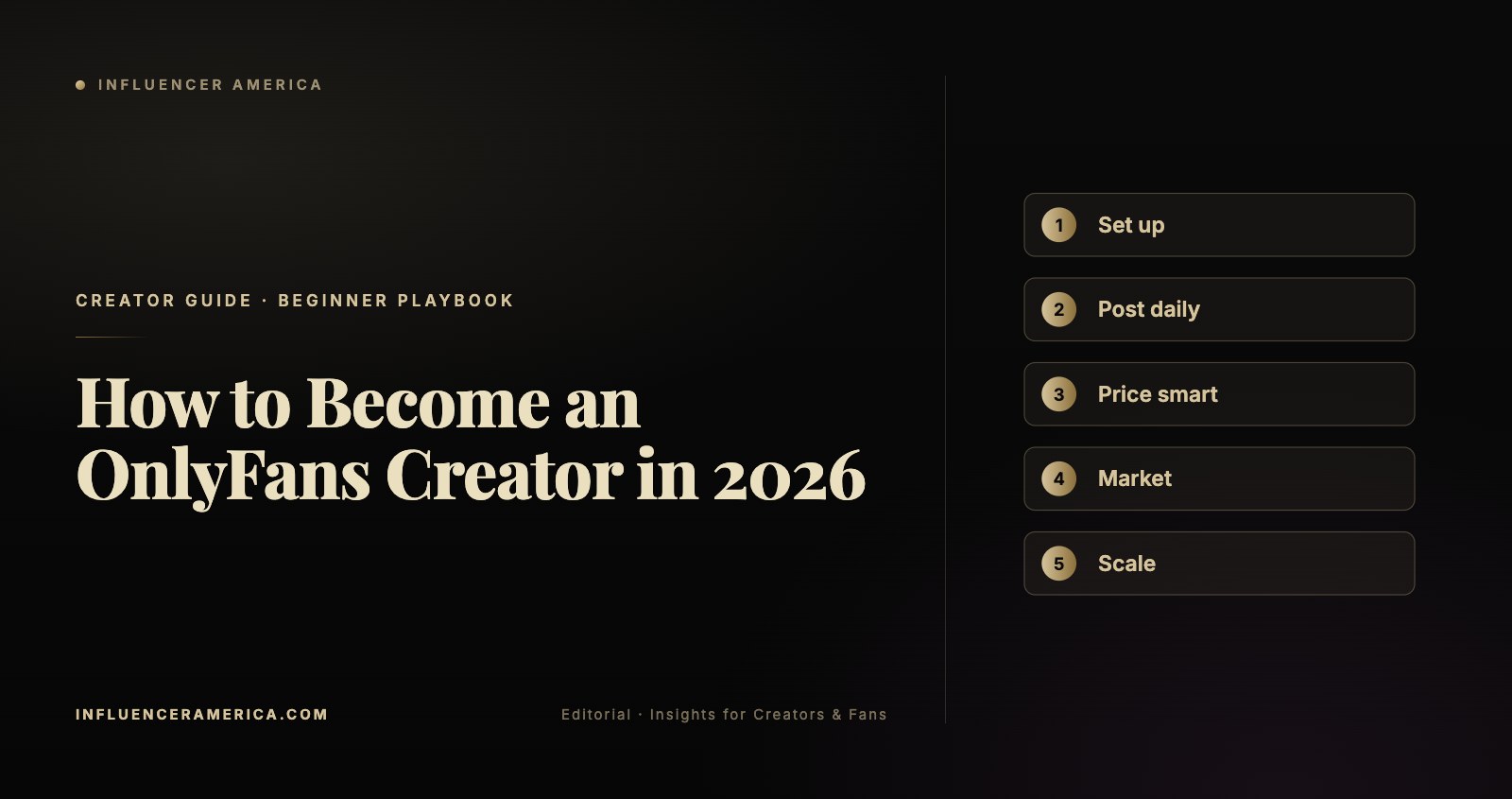
How to Become an OnlyFans Creator in 2026: The Honest Beginner's Playbook
A practical, step-by-step guide to starting as an OnlyFans creator in 2026 — setup, pricing, content strategy, marketing, safety, and how to scale past the beginner plateau.
What Is a Premium Content Creator? The 2026 Guide to Subscription-Based Creators
A plain-English guide to premium content creators — who they are, how subscription platforms work, how creators actually earn, and how fans support the people they follow.